
Ichi the Witch: Externalizing the Internal
Or, bringing out that which is inside.

Preface!
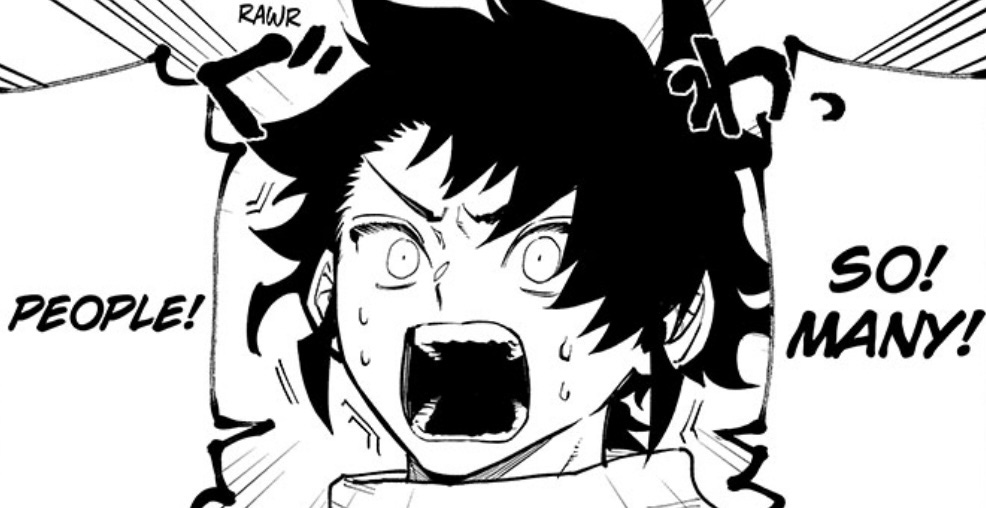
There’s been so much hubbub about Ichi the Witch, but I’ve been putting off reading it because I’m still so far behind on the best witch manga out there—Witch Hat Atelier. But the more I heard about it, the more I realized I just had to at least dip my toe.
Problem is, dipping the toe ended up in me being pulled under.
Sometimes—and not all times, mind you—when I start reading a new series, it takes volumes to really notice something that stands out. Doesn’t mean it’s a bad series, it just means it doesn’t have an immediate nugget of fascination. It could just be a well told story that’s slowly rolling out all of its weapons.
But sometimes, that intriguing hook is right there, right in your face, just waiting for unsuspecting readers to dip their toe.
Preface over.
I’m pretty sure I’ve pulled out this quote before on MangaCraft, but it was Stanley Kubrick who said, “Every story has been told.” That’s a notion that used to scare me in my early days of writing because I felt like the challenge was to create something so innovative that it would defy that notion.
But that’s not the point at all. While Kubrick meant the quote to refer to plot, he went on to add that it’s “our job to do it one better.” Essentially—it’s the telling of the story that’s different. That could mean any number of things, it could mean focus on having a unique voice, a fresh narrative perspective, a dynamic lens into a character we’ve never even imagined existing.
Which is why I find it funny to be analyzing another witch story from the perspective of “doing something fascinating and/or new.”
There are a lot of witch stories out there. And magic stories in general, obviously, so it becomes a matter of what makes one special. What makes this witch story better than the one that came out last week?
For Ichi the Witch, there was no time wasted. A point of intrigue was right there at the start.
Before we get into Ichi the Witch, here’s what you need to know.
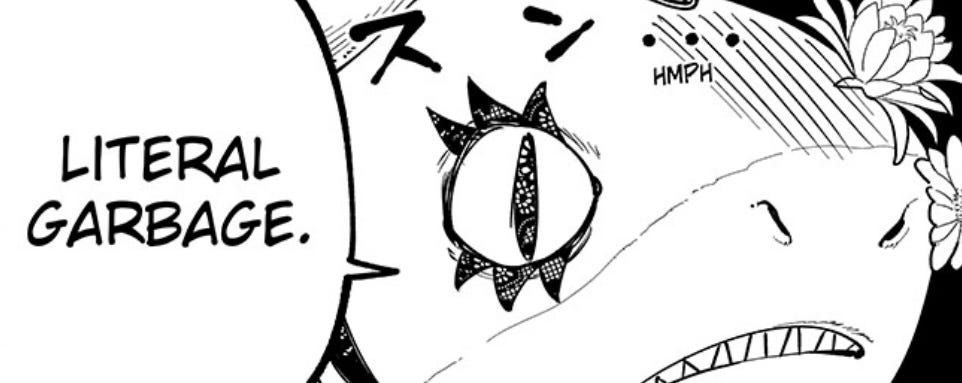
In the world of Ichi, only women can wield magic. The thing is, magic is acquired by overcoming creatures know as majik—note the spelling difference. Each majik has various powers, there are a few thousand of them in the world and only a few hundred are spoken for. So Ichi has spent his life living in the wilderness, hunting for a living, but one day he comes across some witches hunting a majik in his woods and he kills this majik for them, claiming its power, which he shouldn’t be able to do. This majik is Uroro, the king majik. And just like that, Ichi has become the first boy witch in history.
And that’s all you need to know.
Ichi already has a nuance in the magical world of this series—he’s a boy, and only girls can be witches. But that’s not the point of curiosity that I want to focus in on because, frankly, it’s not that superb. It’s a great entry point, but it’s fairly limited in terms of scope and potential. What I want to focus on is the initial magical power Ichi gets, because it creates such a font of curiosity and it’s all nestled inside the main character.
So as mentioned, Ichi takes out Uroro, who is a reverse Witch King of Angmar—he cannot be killed by a woman. Which is a problem since all witches are women. Only Ichi does kill him and take his powers. Uroro is not a fan of this at all, leaving Uroro to be this rebellious source of conflict perpetually attached to Ichi, manifesting as a little blob on his head or shoulder and essentially serving as the demon to Ichi’s angel.
Uroro is always encouraging Ichi to do bad things, or encouraging others to do back things to Ichi. He’s a murderous influence. He regularly tells Ichi to give into Uroro’s power and basically kill everything and become some supremely strong witch.
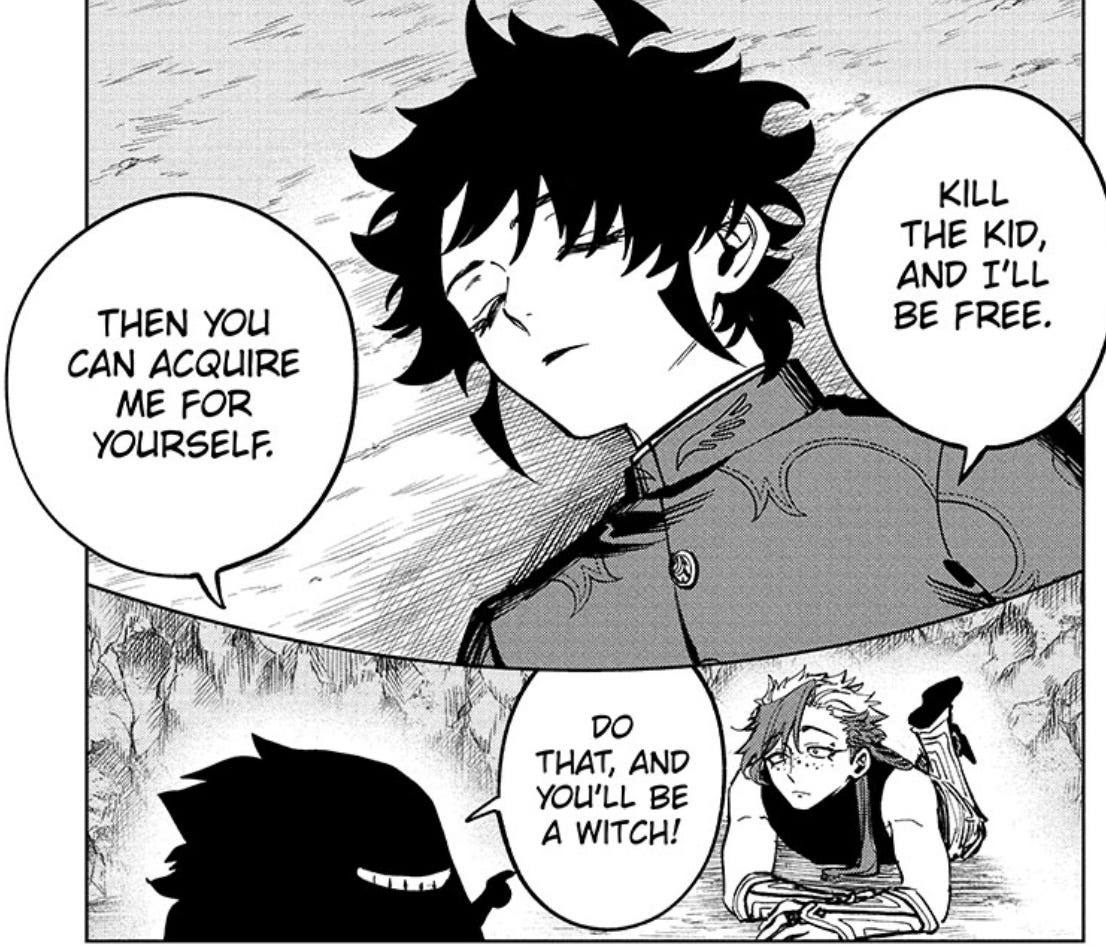
It’s impossible to have a conflict more central to the story than when the source of the conflict lives inside one of the main character. That is a constant source of tension. A constant obstacle to continuously and repeatedly overcome. And even though Ichi side steps the temptations, as readers, it’s not lost on us that the temptation is always there.
It’s feels like—and this is when I start geeking out over the potential of this set-up—this series has externalized the internal conflict. Sure, it’s Uroro suggesting these violent ideas to Ichi, but is this creature also just preying on Ichi’s instincts as a hunter? It’s so on-the-nose that it feels fresh.
Adding to that is Uroro’s power—he amplifies all other magic. Does it stand to reason, then, that he could amplify the most minute urge in Ichi and try to get him to act on it? The urge to hunt? I don’t know the answer to these questions, but the fact that I’m asking all these questions is the whole point—the point of curiosity.
The parallel I’m going to draw to this is so easy to make—it’s Lord of the Rings, y’all. The main conflict is Frodo and the Ring. Frodo has the Ring around his neck—and occasionally around his finger, when he’s being a bad little hobbit—at all times. It’s targeting his self-doubt, his misgivings, all of it.
The conflict is all right there, with him, the entire time. No escaping. It preys on Frodo, it calls to him, begs to be used, begs for Frodo to give in to the ring’s power. And what a temptation that is when Frodo is suffering so much. I mean, the guy can’t even remember the taste of strawberries.
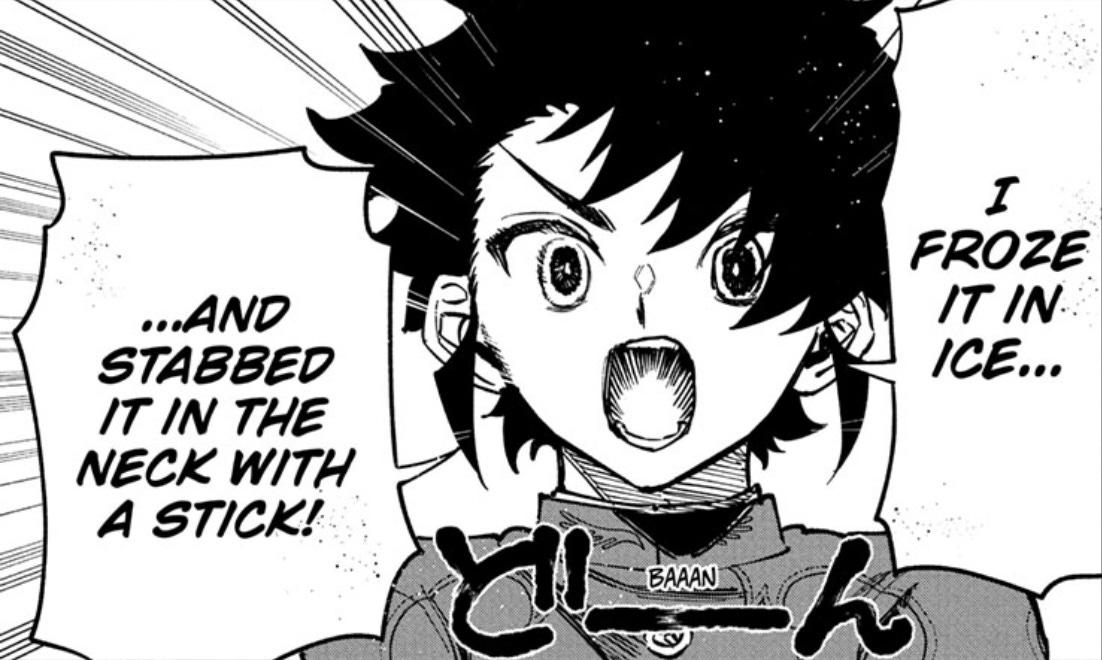
Uroro is doing the same thing to Ichi. Badgering him to just give in to Uroro’s true power and let him go ham on the magical world.
What’s so great about this type of conflict is that no matter where Ichi (or Frodo) goes, there will always be tension. Fighting a monster? Facing a source of tension? Walking through the grocery store? You have a source of power within arm’s reach that can make everything easier.
There’s another parallel I want to draw, because while externalizing an internal conflict is cool, it’s not exactly rare. The Babadook, one of my favorite horror movies, uses a monster to represent the internal difficulties of a single mother struggling with postpartum depression. Monsters are often used in that way, I mean, The Summer Hikaru Died does the same—this monster isn’t just a monster, it’s part of the overarching theme of the story.
But this is different. In those externalized monster horror stories, that monster is the foe, that which must be overcome. Once you overcome it, life can go back to normal. Roll credits.
The ultimate objective is to overcome it.
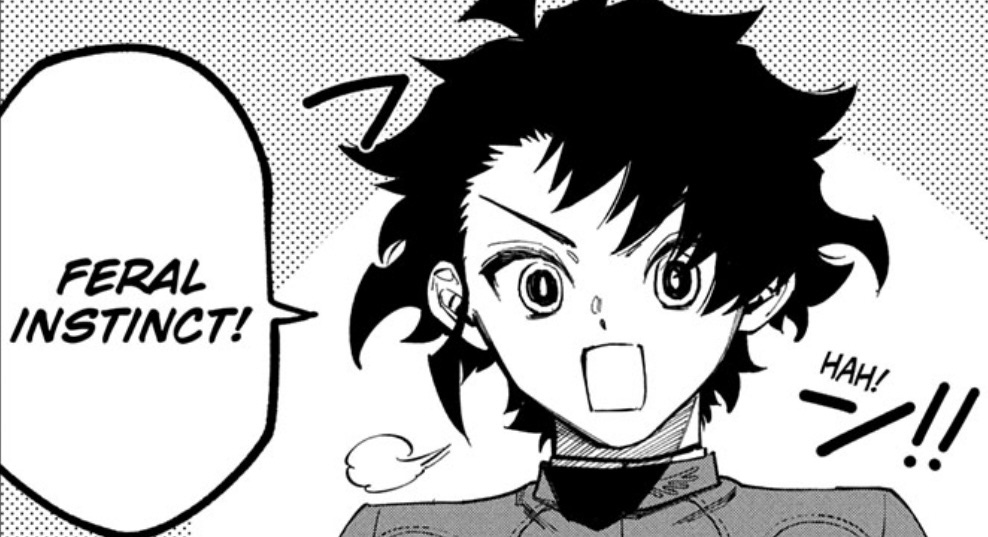
In Lord of the Rings, Frodo’s objective isn’t necessarily to overcome the ring, because that’s not actually possible. He can’t physically do anything to that ring on his own accord. Rather, the objective is to not be overcome by the ring.
The same way I’m seeing Ichi’s objective isn’t to overcome Uroro, he did that already, he beat him in physical combat within the first couple of chapters. His objective is to not be overcome by Uroro.
And that’s where Ichi the Witch throws in a little wrench too, because while Frodo’s difficulties worsen and worsen as he gets closer to Mordor, Ichi has a naivety to him that adds humor to his constant bickering with Uroro. Almost like if Frodo and the One Ring bantered back and forth about the merits of true power on the walk to Mordor.
Fun fact—I don’t actually know if that’s where Ichi the Witch is going, it’s too early in the series. It may very well not be. But the very notion that it could be is fascinating.
Honestly, this is where I thought JJK was going to go with Yuji and Sukuna, and I was pretty disappointed when it didn't.
Another amazing read!